
Last Updated: March 1, 2026 | Reviewed by: The PreppersGoldIRA Team
📌 TL;DR Summary
A silver IRA gives late-start savers a lower entry point than gold. Silver trades near $100 per ounce. Gold trades near $5,000. That price gap means you build physical holdings faster with limited contribution years remaining. The dual-year funding window between January 1 and April 15 lets savers 50 and older contribute up to $16,600 across two tax years. Direct rollovers from old 401(k) accounts move assets without taxes or penalties. Most financial professionals suggest 5% to 20% of total retirement assets in precious metals. Annual custodian and storage fees run $175 to $500 combined. Silver is volatile and requires a 10-year outlook minimum. This article covers mechanics, tax strategy, rollover process, costs, and common mistakes for silver ira late starters.
You ran the numbers at 55. The math did not cooperate. Thirty years of work. Decent salary. Still behind. You are not careless. You are not lazy. Life happened. Medical bills. A divorce. Kids through college. Now the contribution window is shrinking and every dollar needs to count. This page is for you.
📑 Table of Contents
- Why Silver Makes Sense When Time Is Short
- How a Silver IRA Works
- The April 15th Dual-Year Funding Window
- Rolling Over Existing Retirement Accounts
- Real Performance Expectations
- Tax Strategy for Late-Start Savers
- Storage, Security, and Distribution Options
- Balancing Silver with Other Assets
- Silver IRA Late Start Mistakes to Avoid
- Frequently Asked Questions
- Final Thoughts
Your 401(k) balance grew 18% last year. Your purchasing power dropped. The groceries cost more. The insurance premiums climbed. The gap between account statements and real-world buying power keeps widening. Most retirement advice assumes you started saving at 25. You did not. Neither did millions of Americans now facing the same math with fewer years to fix it.
Silver ira late starters are discovering something practical. A tangible asset with a lower entry point than gold. A commodity with industrial demand and monetary history stretching back thousands of years. Not a speculation play. A positioning strategy for people who need every remaining contribution year to count.
Why Silver Makes Sense When Time Is Short
Silver trades near $100 per ounce. Gold trades near $5,000. That difference matters when contribution years are limited.
With $10,000 you acquire roughly 100 ounces of silver. Or about 2 ounces of gold. The psychological difference is significant. You are building tangible holdings. Not scraping together tens of thousands for a fractional position.
The diversification case matters more here. Most pre-retirees hold portfolios dominated by stocks, bonds, and mutual funds. Paper instruments. All dependent on market sentiment and economic conditions. When markets crash these holdings tend to move together. That is exactly when diversification needs to work.
Silver operates on different drivers. Physical commodity. Industrial applications in electronics, solar panels, and medical equipment. Investment demand. Thousands of years of monetary history. During inflationary periods silver has maintained purchasing power when paper assets struggled. That non-correlation is what makes the diversification argument real.
What it means for you: silver gives late starters a way to build meaningful precious metals exposure without requiring massive capital. Every contribution buys substantial physical metal.
How a Silver IRA Works
A silver IRA is a self-directed individual retirement account holding physical silver. The structure maintains all standard IRA tax advantages. The process involves more steps than buying an index fund. Worth understanding before committing.
You work with a custodian specializing in self-directed IRAs. These are not typical brokerage firms. They handle IRS compliance, paperwork, and regulatory requirements for alternative assets like precious metals, real estate, or private equity. You control investment decisions. They confirm everything stays within IRS legal boundaries.
Once established you fund the account through direct contributions or rollovers from existing retirement accounts. The custodian coordinates with approved dealers to purchase IRS-qualified silver. Not any silver qualifies. It must meet .999 fine purity standards from approved mints or refiners.
The silver never comes to your house during the IRA phase. Storage happens in an IRS-approved depository. Professional vault. Insurance. Regular audits. You own the silver. Title sits in your IRA name. Professional storage continues until you take a distribution or liquidate.
Traditional Silver IRA contributions may be tax-deductible. Growth is tax-deferred until withdrawal. Roth Silver IRA contributions use after-tax dollars. Qualified withdrawals come out completely tax-free. The mechanics mirror standard retirement accounts. The underlying asset is physical metal instead of paper.
The April 15th Dual-Year Funding Window
This catches people off guard. If you are 50 or older a window opens between January 1 and April 15 each year. You can contribute to both the previous year and current year simultaneously.
For 2026 the standard IRA contribution limit is $7,500. The catch-up contribution for those 50 and older adds $1,100. That totals $8,600. During the January through mid-April window you can also make your 2025 contribution if not already maxed. That means up to $16,600 during one short period.
People lose years of contribution room because they do not know this exists. If you delayed contributions or failed to maximize your IRA in previous years this window gives you a chance to accelerate.
The timing also creates a tax planning opportunity. Reduce your 2025 taxable income when filing by April 15. Simultaneously start your 2026 contributions. For someone in a higher bracket managing tax liability while building retirement assets this accomplishes both goals at once.
What it means for you: the dual-year window is the single fastest way for a silver ira late saver to close the gap. $16,600 into physical silver in one quarter changes the trajectory.
Rolling Over Existing Retirement Accounts
Rollovers are where late-stage planning gets interesting. If you changed jobs over the years you may have a 401(k) sitting with a former employer. Or a traditional IRA that never fit a comprehensive strategy.
Direct rollovers from these accounts into a silver IRA are tax-neutral events. No taxes. No penalties. No distributions counting as income. Funds transfer between qualified retirement accounts and get repositioned into physical silver. The IRS treats this as an administrative move.
This works well for people with 401(k) balances between $50,000 and $200,000 who are five to ten years from retirement. Large enough for meaningful precious metals holdings. Not so large that repositioning creates excessive concentration risk.
Rolling over 10% to 20% of total retirement assets into silver immediately diversifies the portfolio. For a silver ira late saver this repositioning would take years through regular contributions alone.
The mechanics require paperwork. Reputable custodians handle the heavy lifting. You start the rollover request. The old custodian transfers funds to the new custodian. The new custodian purchases silver on your behalf. The process typically takes two to four weeks. When complete you have fundamentally changed your asset allocation.
If you are exploring how rollovers work for precious metals more broadly our complete rollover guide covers the step-by-step process.
Real Performance Expectations
Precious metals marketing sometimes oversells the upside. Here is the reality.
Silver has had exceptional periods. From 2008 to 2011 it moved from around $9 to nearly $50 per ounce. That outperformed most traditional assets significantly. But it also corrected brutally. Back to the mid-$20s by 2013. Relatively flat for years after that. From 2020 onward silver climbed steadily as inflation concerns grew, eventually pushing toward $100 per ounce by early 2026.
The volatility is real. More pronounced than gold. Silver responds to economic conditions, industrial demand, investment flows, and currency movements. During economic uncertainty it often rallies. During stable growth with low inflation it can stagnate.
For someone in their late 50s or 60s this volatility requires the right timeframe. If you plan to tap these assets in five years silver may not be ideal.
If you are positioning for your 70s and beyond a silver position held through market cycles is a different proposition entirely. You are diversifying long-term holdings. Not timing the market. Every silver ira late starter needs to understand that distinction.
Ownership costs deserve acknowledgment. Annual custodian fees typically run $75 to $300 depending on account size. Storage fees at IRS-approved depositories add $100 to $200 annually. These costs eat into returns compared to a zero-fee index fund. Factor them into expected performance. Decide whether the diversification justifies the expense.
Understanding the historical performance of precious metals helps set realistic expectations for any metals-based retirement strategy.
📘 Free Download: The Retirement Rescue Gold IRA Playbook
Learn how 12,000+ readers are using precious metals to build a more resilient retirement. Covers allocation strategies, rollover mechanics, and custodian selection in plain language.
🧮 How Much Silver Belongs in Your Portfolio?
Use this calculator to see a recommended allocation based on your portfolio size, age, and risk profile. The numbers adjust to your specific situation.
Want access to all 16 interactive tools? Visit the Gold IRA Playbook for calculators, scorecards, and comparison tools.
Tax Strategy for Late-Start Savers
Outside a retirement account silver sales trigger capital gains taxes at collectibles rates. Up to 28%. That is higher than standard long-term rates for stocks and bonds.
Inside a Traditional IRA your silver gains are not taxed until withdrawal. At that point they are taxed as ordinary income. Depending on your retirement tax bracket this could be better or worse than collectibles rates. If you expect a lower bracket after retiring the Traditional route offers clear advantages.
The Roth structure gets interesting for catch-up savers. If you are in your late 50s or early 60s with a few years of higher income remaining you can make Roth contributions now. Pay taxes at your current rate. Then enjoy completely tax-free growth and distributions in retirement.
A Roth conversion strategy also deserves consideration. Convert existing Traditional IRA funds into a Roth IRA. Pay the taxes on the conversion amount. Then enjoy tax-free growth going forward. For someone who expects silver to appreciate over the next 10 to 20 years converting before the appreciation happens means all that growth is tax-free. Conversions work especially well during years when income dips temporarily.
Our comparison of traditional IRA, Roth, and precious metals IRA structures breaks down the tax implications side by side.
What it means for you: a Roth conversion before silver appreciates locks in tax-free growth. Pay the taxes now at your current rate. Never pay them again on those gains.
Storage, Security, and Distribution Options
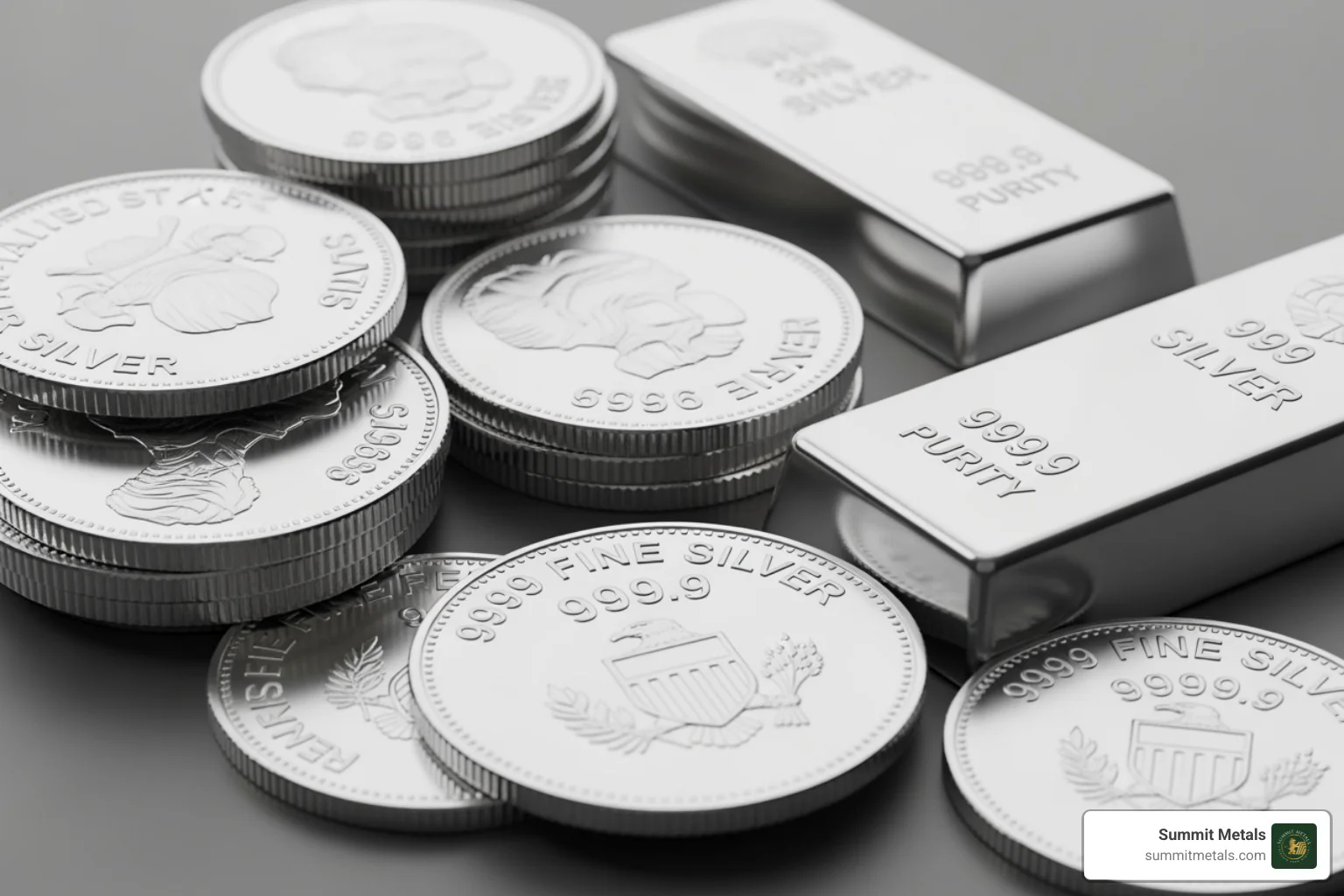
IRS-approved depositories are serious operations. Vault storage. 24/7 security. Insurance coverage. Regular audits. Your silver is allocated to your account specifically. Not pooled with other investors in a way that creates counterparty risk.
Storage is segregated. Your specific bars or coins are identified and separated. You receive documentation showing exactly what you own. Serial numbers included. You have actual ownership of physical metal. Not a stock certificate representing a claim on assets.
When you reach age 59 and a half you have options. Take physical delivery shipped to your address. Keep it in storage and liquidate portions as needed with proceeds distributed as cash. Or take required minimum distributions in kind receiving physical silver you can keep or sell privately.
The ability to request physical delivery matters psychologically. You can call your custodian and have actual silver bars shipped to your door. The value does not depend on any company solvency. Any stock performance. Any financial institution stability. Metal you own. Stored securely until you want it. For silver ira late planners this tangibility matters.
Balancing Silver with Other Retirement Assets
Silver works best as one component. Not a complete retirement solution.
Most financial professionals recommend precious metals comprise 5% to 20% of a total retirement portfolio. The exact percentage depends on risk tolerance, existing assets, and catch-up goals. Someone with strong Social Security and a pension might allocate 5%. Someone with minimal guaranteed income and significant ground to cover might lean toward 15% or 20%.
Silver complements traditional investments. You still want stock exposure for growth. Bonds for income and stability. Cash reserves for liquidity. Silver adds inflation resistance, market non-correlation, and tangible asset exposure the other categories cannot replicate.
Think of silver as portfolio insurance. You hold it because when other assets struggle during inflationary periods, currency instability, or financial system stress precious metals tend to hold or increase value. That characteristic becomes more valuable the closer you get to retirement. Less time to recover from market downturns means more need for assets that behave differently. Silver ira late planning is about positioning for resilience.
If you are weighing precious metals against traditional retirement options our comparison of gold IRAs, stocks, and cash provides a framework for the decision.
Silver IRA Late Start Mistakes to Avoid
Overconcentration. Moving 40% or 50% of retirement savings into silver creates enormous volatility risk. It eliminates the diversification benefits that made silver attractive initially. Appropriate allocation matters more than maximum allocation.
Market timing. Waiting for silver to hit an arbitrary price point. Or panic selling during corrections. With limited years before retirement timing precious metals markets is counterproductive. Dollar-cost averaging through regular contributions or establishing a position and holding it through cycles works better than chasing perfect entry points.
Choosing on price alone. Selecting custodians or dealers based solely on the lowest fee without considering reputation, service quality, or transparency. A slightly higher fee from a reputable provider is worth it compared to savings from a company with questionable practices.
Ignoring estate planning. Precious metals IRAs transfer to beneficiaries like traditional IRAs. But beneficiary designations need to be current. Heirs need to understand what you own and how to access it. Families have discovered precious metals holdings after a parent passed with no idea how to take possession or liquidate. Talk to your family now.
For a comprehensive look at what separates reputable precious metals companies from the rest our complete guide to gold IRAs covers the fundamentals every silver ira late starter should know.
Ready to explore your silver IRA options?
Request Your Free Silver IRA Information Kit
Affiliate link. We may earn a commission at no extra cost to you. See our affiliate disclosure.
❓ Frequently Asked Questions
Can I roll over my 401(k) into a silver IRA without penalty?
Yes. A direct rollover transfers funds from your 401(k) custodian to your new self-directed IRA custodian. The money never touches your hands. The IRS treats it as a non-taxable event. You maintain tax-advantaged status while repositioning into physical silver. The process typically takes two to four weeks. You can roll over funds from old 401(k) accounts left with previous employers or from current employer plans after leaving that job.
How much silver should I hold in my retirement portfolio?
Most financial professionals recommend 5% to 20% of total retirement assets in precious metals. Someone with a pension and strong Social Security might stay closer to 5%. Someone with fewer guaranteed income sources and larger savings gaps might allocate 15% to 20%. The purpose is diversification and purchasing power preservation. Silver should complement stocks, bonds, and cash. Not replace them.
What are the annual fees for a silver IRA?
Silver IRAs involve three main fee categories. Annual custodian fees range from $75 to $300 depending on account size and services. Storage fees at IRS-approved depositories run $100 to $200 per year. Dealer premiums apply when purchasing silver and vary by product type and market conditions. Some custodians charge one-time setup fees of $50 to $150. These costs are higher than zero-fee index funds. Factor them into your return calculations.
Can I take physical possession of my silver?
Yes. After age 59 and a half you can request physical delivery. The depository ships your actual bars or coins directly to your address. You can also liquidate portions and receive cash. Or take required minimum distributions in kind. Before age 59 and a half taking possession triggers early withdrawal penalties of 10% plus ordinary income taxes on the distributed amount.
Is a silver ira late start worth the effort?
Silver offers a lower entry point than gold. You build physical holdings faster with the same dollar amount. Silver is more volatile than gold which creates both opportunity and risk. Gold tends to be more stable and is the standard precious metals allocation for most retirement portfolios. Many late-start savers use both. Silver for volume and upside potential. Gold for stability. The right mix depends on your timeline, risk tolerance, and existing portfolio.
Does silver perform well during inflation?
Silver has historically performed well during high inflation periods. During the stagflation of the late 1970s silver prices increased dramatically while stocks struggled. From 2020 through 2026 silver climbed from the teens toward $100 as inflation concerns persisted. Over very long periods stocks have generally provided higher total returns. The value of silver comes from its non-correlation with equities. When inflation pressures cause stock declines silver often moves differently.
Can I store my IRA silver at home?
No. IRS regulations require silver held in an IRA be stored in an approved depository. You cannot store it at home, in a personal safe, or in a bank safe deposit box. The IRS mandates professional storage meeting specific security, insurance, and auditing requirements. Taking physical possession before age 59 and a half triggers taxes and a 10% early withdrawal penalty. After retirement age you can have the silver shipped home and store it however you choose.
What happens to my silver IRA when I pass away?
Your silver IRA transfers to designated beneficiaries like any other IRA. Spousal beneficiaries can roll it into their own IRA and delay distributions. Non-spousal beneficiaries must take distributions within ten years under current rules. The silver stays in secure storage during the transfer. Current beneficiary designations and clear communication with heirs about your holdings makes the process smoother.
Final Thoughts
A silver ira late start is still a start. The math will never be as good as it would have been at 30. But the math at 55 or 60 is better than the math at 65 with zero diversification.
Silver gives late-stage savers something tangible. An asset with industrial demand. A commodity with thousands of years of monetary history. A position you build quickly because the entry point is low. Not a miracle solution. A practical tool for people making up ground.
The dual-year funding window. The rollover option. The Roth conversion strategy. These mechanics exist specifically for people in catch-up mode. Most people never learn about them until the window closes.
Now you know. The question is what you do with the next contribution year.
Affiliate link. See our affiliate disclosure.
— The PreppersGoldIRA Team
The 62-year-old postal worker watching his TSP grow on paper while groceries eat the real gains. The small business owner who built something from nothing but put retirement last. The federal employee three years from eligibility wondering if the pension alone will be enough. Every one of them waited. Every one of them can still act. The window is open. But windows close.
📚 Related Resources
- How to Roll Over Your 401(k) Into a Gold IRA – Step-by-step rollover process and custodian selection
- Traditional IRA vs Roth vs Gold IRA – Tax structure comparison for precious metals accounts
- Gold IRA vs Stocks vs Cash – Performance comparison across asset classes
- What Is a Gold IRA? – Complete beginner guide to precious metals retirement accounts
- Gold Investment Over Time – Historical precious metals performance data
📋 Legal Information
For complete transparency and your protection, please review:
- Terms of Service – Rules governing use of this website
- Disclaimer – Important limitations on our content and advice
- Privacy Policy – How we collect and use your information
- Affiliate Disclosure – How we earn commissions
These pages are part of our commitment to full transparency and legal compliance.