Silver Home Storage: Best Options for Physical Silver
Silver home storage is the question nobody asks until the silver is already in the house. Then it’s urgent.
You’ve got $5,000 worth of eagles sitting in a shoebox and a vague plan to “figure it out later.” Later is now. Getting silver home storage wrong means theft, moisture damage, or an insurance payout that won’t cover half of what you lost.
This article ranks every silver home storage option by security, cost, and access. No marketing language. Just the real tradeoffs.
🔒 Need a Safe Now? Browse Home Storage Options on Amazon
Heavy-duty home safes rated for fire and burglary — multiple sizes and price points, Prime shipping available. A practical starting point while you research the full options below.
Shop Home Safes on Amazon →Amazon affiliate link — we may earn a commission if you make a purchase. This does not affect our editorial coverage.
► Quick Summary — What You Need to Know
Silver home storage options ranked from weakest to strongest: hidden compartments (low cost, low security), fireproof document safes (cheap but not burglary-rated), quality bolted floor safes (good middle ground), large heavy-duty safes (solid, high-volume), and purpose-built precious metals safes (best overall). Each has tradeoffs on weight, cost, installation, and access speed.
Three things every silver stacker must address before anything else: insurance rider on your homeowners policy, moisture control inside the storage container, and bolt-down installation. Without all three, even the best safe is incomplete. This article covers every option, every real cost, and what each one gets right and wrong.
You prepared for the grid going down.
You’ve got water, food, a generator, and now physical silver. You finally own something real. Something no government can print more of.
And then it sits in your sock drawer because you haven’t gotten around to the safe yet.
The contractor in Tennessee who stacked 200 ounces over three years. The retired Marine in Georgia with $8,000 in eagles under a floorboard. The small business owner in Iowa who finally got serious about real assets — and then left them more exposed than his savings account.
Silver home storage is the last step in the stack. Don’t skip it.
► Table of Contents
- Three Things to Do Before Picking a Storage Option
- Option 1: Hidden Compartments and Diversion Safes
- Option 2: Fireproof Document Safes
- Option 3: Quality Floor Safes
- Option 4: Large Heavy-Duty Safes
- Option 5: Purpose-Built Precious Metals Safes
- Storage Options Compared: Side-by-Side Table
- The Insurance Gap Most Preppers Miss
- Moisture and Tarnish: The Silent Threat
- Where to Buy Physical Silver
- Frequently Asked Questions
Three Things to Handle Before You Pick a Silver Home Storage Option
Every silver home storage option on this list is incomplete without these three things in place first.
1. Call your insurance company today. Most standard homeowners policies cap precious metals coverage at $1,000 to $2,500. Full stop.
You can have $20,000 in silver eagles in the best silver home storage safe money can buy and collect $2,500 after a theft. You need a scheduled personal property rider that specifically covers precious metals. It costs $50 to $150 a year for most stacks. Not optional.
2. Keep a detailed inventory. Photograph every coin and bar. Note weight, mint, purity, and purchase price. Store the inventory off-site — in a cloud account, a safety deposit box, or with a trusted family member. Without documentation, insurance claims get complicated fast.
3. Tell no one. The biggest security variable is human. A contractor who worked in your house. A neighbor who noticed the delivery. A family member who mentioned your stack to someone. Silver home storage security starts with operational security. Not just the safe.
The practical takeaway: The best safe in the world doesn’t protect you from an insurance gap or a loose conversation. Handle those first.
Option 1: Hidden Compartments and Diversion Safes
What it is: Fake books, hollowed furniture, false-bottom drawers, wall cavities, buried containers. The idea is concealment over resistance.
Cost: $0 to $200 depending on DIY vs. purchased diversion safe.
What it gets right: Fast access. Zero installation hassle. Good as a secondary layer for smaller amounts. A motivated burglar who gets spooked and leaves quickly may never find it.
What it gets wrong: Professional burglars know every hiding spot. They check the fake books, the hollowed cans, the master bedroom closet shelf. A professional can clear a house methodically in under 20 minutes. Concealment-only silver home storage is a single point of failure.
Best used as: A decoy layer alongside a real safe. Keep $200 in junk silver in a visible spot. Keep the real stack locked and bolted.
Bottom line: Not a silver home storage solution on its own. A useful layer in a layered system.
Option 2: Fireproof Document Safes
What it is: The basic home safes sold at big-box stores. SentrySafe, First Alert, similar brands. Typically 30-minute or 60-minute fire ratings.
Cost: $50 to $400.
What it gets right: Protects against fire. Cheap. Widely available. Better than nothing for someone just starting their silver home storage setup.
What it gets wrong: These are not burglary-rated. They are thin-gauge metal with basic locks. A pry bar and 60 seconds is all it takes.
They are also light — most weigh under 40 pounds, which means they can be carried out entirely. If it isn’t bolted to the floor or wall, it is not a complete silver home storage solution.
The moisture problem: Fireproof safes are designed to trap moisture to protect paper documents during a fire. That trapped moisture corrodes silver. If you use one, place desiccant packets inside and replace them every 90 days.
Bottom line: Acceptable as a starting point for small stacks under $2,000. Upgrade as your position grows.
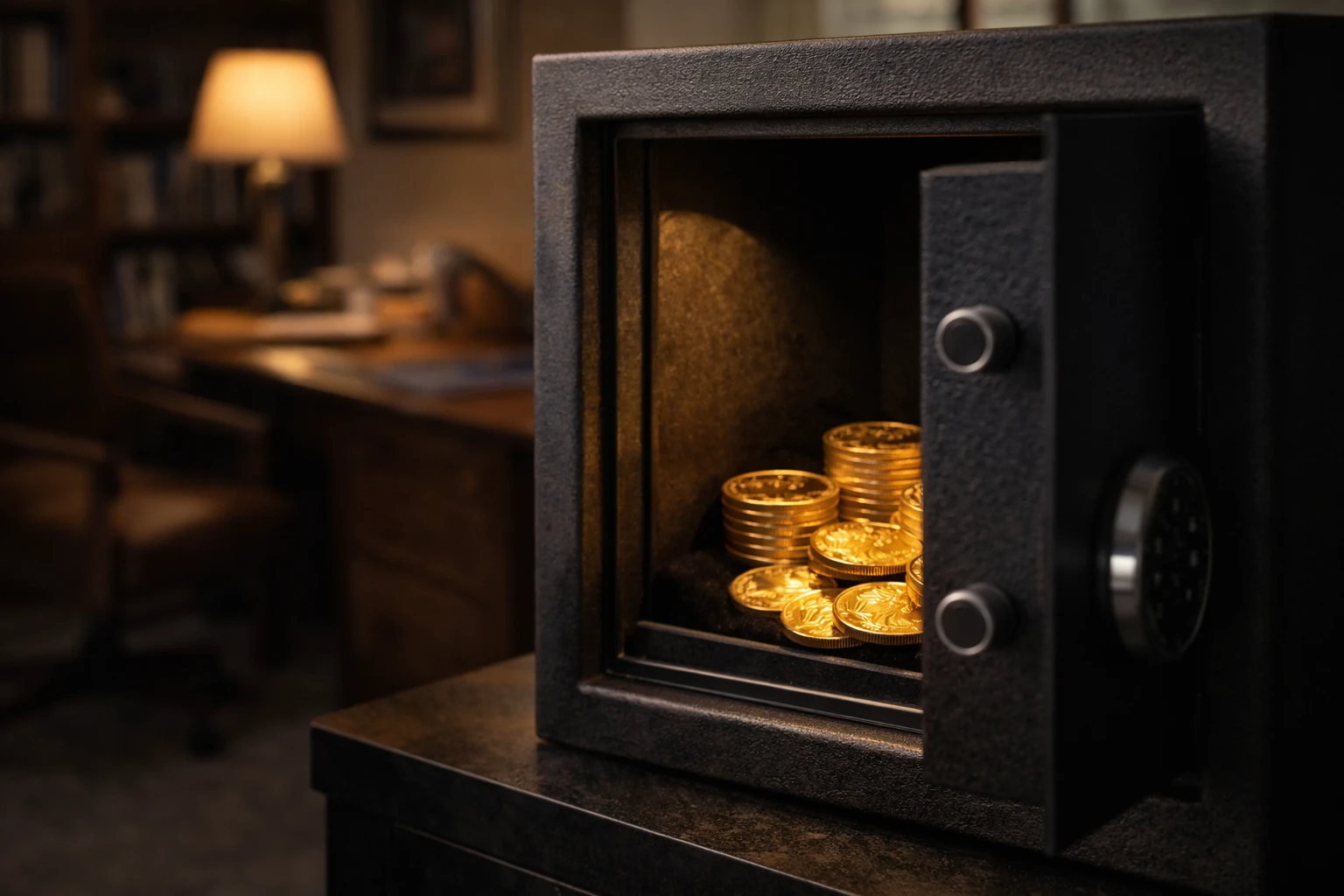
Option 3: Quality Bolted Floor Safes
What it is: A true burglary-rated safe — steel body, deadbolt locking mechanism, UL listed rating. Brands like Liberty, American Security (AMSEC), Fort Knox. Bolted into the floor or wall.
Cost: $400 to $1,500 for a solid mid-range unit. Professional installation adds $100 to $200.
What it gets right: Proper burglary resistance. Can’t be carried out if bolted correctly. Combination or electronic lock. Fire rating available on higher-end models. The best silver home storage value for most preppers with stacks in the $5,000 to $25,000 range.
What it gets wrong: A determined thief with time and tools can defeat most units under 500 pounds. The goal is to make it take long enough that they leave. Most residential burglaries last under 10 minutes. A properly bolted quality safe defeats the time constraint.
Installation matters: Concrete anchoring is stronger than wood subfloor anchoring. If you’re on a slab, use concrete anchor bolts. If you’re on a wood floor, bolt through the subfloor and into a floor joist where possible.
Translation: This is the right answer for most PGIRA readers with meaningful silver positions. Buy the best unit your budget allows. Bolt it. Done.
Option 4: Large Heavy-Duty Safes
What it is: Large-capacity heavy safes in the 400 to 1,000+ pound range. Brands like Browning, Rhino, Cannon, Liberty Presidential. Designed for volume storage. Require two or more people to move even unbolted.
Cost: $800 to $3,000+.
What it gets right: Mass is security. A 700-pound safe bolted to a concrete slab is not going anywhere. The volume is ideal for precious metals — silver stacks take up significant physical space per dollar of value. These safes store a substantial silver and gold position with room to grow.
What it gets wrong: Not all heavy safes are UL burglary rated. Check the specific model. Some rely on weight alone — not steel gauge. Look for UL RSC (Residential Security Container) certification minimum.
The practical argument: If you own both precious metals and firearms, a quality heavy safe handles both in one installation. One combination. One bolted location. Everything secured together.
For your portfolio: Best silver home storage option for serious stackers who need volume. Look for UL RSC certification and minimum 10-gauge steel body.
🔒 Building a Real Financial Fortress Takes More Than a Safe
The Gold IRA Playbook covers precious metals strategy from allocation to storage to dealer selection. Free tools. No pressure.
Get the Free Playbook →Option 5: Purpose-Built Precious Metals Safes
What it is: High-security safes built specifically for precious metals storage. Thick steel, UL TL-15 or TL-30 rated (tool-resistant for 15 or 30 minutes), heavy composite construction.
Cost: $2,000 to $10,000+.
What it gets right: This is the gold standard of silver home storage. TL-30 rated means a professional attacker with power tools takes at least 30 minutes to breach it.
That is long past when any residential burglar would have abandoned the job. These safes also manage humidity better than standard fire safes. Less moisture damage to your stack over time.
What it gets wrong: Cost. Weight — some units run 1,500+ pounds and require professional moving equipment. Overkill for a $5,000 silver stack. The right fit for serious stackers with $50,000+ in physical metals at home.
Key brands: Gardall, AMSEC, Hayman, Brown Safe. Buy from a local safe dealer, not online. Installation matters more than shipping convenience at this price point.
Here’s the real impact: If your stack justifies this investment, make it. If it doesn’t yet, build toward it. The right safe grows with your position.
Silver Home Storage Options Compared
All five silver home storage options side by side. Use this to match your stack size to the right solution.
| Option | Cost | Burglary Rating | Fire Rating | Best Stack Size | Verdict |
|---|---|---|---|---|---|
| Hidden Compartments | $0-$200 | None | None | Decoy only | Layer only. Not standalone. |
| Fireproof Document Safe | $50-$400 | Low | 30-60 min | Under $2,000 | Starter only. Must bolt. |
| Quality Floor Safe | $400-$1,500 | UL RSC rated | 60 min (some models) | $2,000-$25,000 | Best value for most stackers. |
| Large Heavy-Duty Safe | $800-$3,000 | UL RSC (check model) | 60-90 min | $5,000-$50,000 | Best for high-volume stacks. |
| Purpose-Built Metals Safe | $2,000-$10,000+ | TL-15 / TL-30 | 60+ min | $50,000+ | Best overall. For serious stackers. |
Wattson here.
I’ve talked to a lot of guys who stacked silver and didn’t sort out the silver home storage until something scared them into it.
A break-in on the block. A contractor who asked too many questions. A kid who found the stash while looking for Christmas presents.
The 62-year-old retired plumber in Missouri who finally bought the Liberty safe he’d been putting off for two years. The Army vet in North Carolina who bolted his heavy-duty safe to the slab the week after his neighbor’s house got hit.
They all said the same thing after: should have done it sooner.
You built the stack. The silver home storage piece is the last 10% of the job. Don’t let it be the part that undoes the other 90%.
Make your own call.
The Insurance Gap Most Silver Stackers Miss
Standard homeowners policies treat precious metals like jewelry. They cap coverage at $1,000 to $2,500 regardless of actual value. A $15,000 silver stack insured under a standard policy pays out $2,500 after a theft.
The fix is a scheduled personal property rider, also called a floater. You declare the specific items and their appraised value. The insurer covers them for that amount. Cost runs $1 to $2 per $100 of coverage annually.
On a $10,000 silver position, that’s $100 to $200 a year. That is the actual cost of insuring your stack. Most insurance companies offer this. Call yours and ask specifically about a precious metals rider. Get the coverage amount in writing.
Keep your purchase receipts. Keep your inventory photographs. Store copies off-site. Insurance claims require documentation. Without it, you’re negotiating against the insurer’s estimate of what silver was worth.
Why this matters: A safe protects your silver from thieves. Insurance protects you financially if the thief wins. You need both.
Moisture and Tarnish: The Threat Inside the Safe
Silver tarnishes. It’s a chemical reaction with sulfur compounds in the air. It doesn’t destroy silver’s value but it affects appearance, and heavy tarnish can complicate resale if buyers confuse it with damage.
Inside a closed safe, humidity accelerates the problem. Every time you open and close the safe, you introduce humid air. That moisture has nowhere to go.
The solution is simple and cheap. Use silica gel desiccant packets inside your safe. Replace them every 60 to 90 days or regenerate them in a warm oven. A rechargeable desiccant unit like a Goldenrod dehumidifier rod works well for larger safes.
Store coins in their original capsules or airtite holders where possible. Tubes are fine for bulk storage. Avoid PVC flips — they contain plasticizers that can react with silver over time.
Translation: A $5 pack of desiccant protects a $10,000 stack from a problem most people don’t think about until it’s too late.
🔮 Your Silver Stack Is Only as Strong as Your Full Plan
The Gold IRA Playbook covers allocation, storage, dealer selection, and what to ask before you buy anything. Free access. No email required to use the tools.
Access the Free Playbook →Where to Buy Physical Silver Worth Storing
Silver home storage only matters if you own silver worth protecting. Here are four vetted dealers with track records long enough to mean something.
Noble Gold
Handles both physical silver for home delivery and silver IRA setup. Good option if you want guidance on what to buy before you store it.
See Noble Gold’s Silver Options →Affiliate link — we may earn a commission if you open an account. This does not affect our editorial coverage.
JM Bullion
Established 2011. A+ BBB rating. Free shipping over $199. Consistent pricing on American Silver Eagles, Maples, and 10-oz bars. Good for checking live premiums before you commit.
Compare silver at JM Bullion →Affiliate link — we may earn a commission if you make a purchase. This does not affect our editorial coverage.
SD Bullion
Founded 2012. Known for competitive premiums on silver rounds and bars. Good for bulk stacking where per-ounce cost matters most.
Check premiums at SD Bullion →Affiliate link — we may earn a commission if you make a purchase. This does not affect our editorial coverage.
Kitco
In the market since 1977. Strong reputation for real-time pricing data and a broad selection across all precious metals. Good for cross-checking spot prices before any purchase.
View silver at Kitco →Affiliate link — we may earn a commission if you make a purchase. This does not affect our editorial coverage.
► Frequently Asked Questions
What is the best silver home storage option for most people?
For most stackers with $5,000 to $25,000 in physical silver, a UL RSC-rated bolted floor safe in the $400 to $1,500 range is the right answer. It provides real burglary resistance, can be installed in a day, and costs a fraction of what your stack is worth. Pair it with a precious metals insurance rider and desiccant inside the safe.
Does homeowners insurance cover silver stored at home?
Standard policies cover precious metals up to $1,000 to $2,500. That is almost certainly less than your stack is worth. You need a scheduled personal property rider specifically covering precious metals. Call your insurer, declare your stack value, and get the rider in writing. It typically costs $1 to $2 per $100 of coverage annually.
Where should I NOT store physical silver at home?
Avoid the master bedroom closet — it’s the first place professional burglars check. Avoid the garage — temperature and humidity swings damage silver over time. Avoid anywhere wet, including basements prone to flooding. And never rely on a single hiding spot without a backup plan.
How do I prevent silver from tarnishing in storage?
Use silica gel desiccant packets inside your safe and replace them every 60 to 90 days. Store coins in airtite capsules or original mint tubes. Avoid PVC flips. Keep the safe away from humidity sources. A rechargeable dehumidifier rod works well for larger safes.
Should I tell anyone where my silver is stored?
As few people as possible. Operational security is part of silver home storage strategy. Theft is most often connected to someone who knew the stack existed. A trusted spouse or family member designated to access the safe in an emergency — that is reasonable. Beyond that, the less said, the better.
Is a bank safety deposit box a good silver home storage alternative?
It solves the home security problem but creates others. Safety deposit box contents are not FDIC insured. Banks can be closed by regulators. Access depends on bank hours.
In a grid-down scenario or banking crisis, you may not be able to reach it. For preppers who value access in an emergency, proper silver home storage with a quality bolted safe is the more resilient option.
Silver Home Storage: The Last Step in the Stack
You did the hard part. You bought real silver. You took possession. You hold something no central bank can print more of.
Silver home storage is the final piece. Get it wrong and the stack you built over years is gone in ten minutes.
A bolted, burglary-rated safe. An insurance rider. Moisture control. Operational security. Those four things together are a complete silver home storage system. None of them are expensive relative to what they protect.
This is educational content only. It is not financial or legal advice. Consult a licensed professional before making any investment decisions.
Make your own call.
You’ve got the generator. The food storage. The water filtration. The solar backup.
You prepared for the grid going down. For the supply chain breaking. For the moment when paper stops working and real things matter.
Now you have silver. Something real. Something portable. Something that has been money for 5,000 years without needing a server farm to validate it.
Protect it like you protect everything else you’ve built. Not with panic. With the same quiet competence you brought to the rest of your preparation.
The safe is just the next logical step.
Related Resources
This content is for educational purposes only. It is not financial, legal, or tax advice. Consult a licensed professional before making any investment decisions.
Terms of Service | Disclaimer | Privacy Policy | Affiliate Disclosure