
Last Updated: January 9, 2026 | Reading Time: 12 minutes
🔍 TL;DR – Quick Summary
Click to Expand Quick Summary
This gold rounds comparison breaks down rounds vs coins vs bars for preppers protecting retirement wealth. Gold rounds carry lower premiums than government coins ($30-60 vs $60-120 per ounce). Government coins sell faster in emergencies. Quality rounds from PAMP Suisse or Perth Mint offer the best balance. Avoid generic no-name rounds and small bars. Smart strategy: 60% quality rounds, 40% government coins. For actual barter, silver works better than gold for small transactions.
You stacked your first gold piece after watching the 2008 crash wipe out half your neighbor’s retirement. Made sense then. Makes more sense now. But every dealer pushes something different. Eagles. Maples. Rounds. Bars. Each one claims to be the smart choice.
Meanwhile, you’re trying to figure out which form actually sells when you need cash and which one sits in your safe collecting dust because nobody recognizes it. The premium you paid upfront means nothing if you can’t move it when the time comes.
📋 Table of Contents
Click to Expand Table of Contents
- What Are Gold Rounds?
- The Full Gold Rounds Comparison
- Why Premiums Matter More Than You Think
- What Happens When You Sell or Trade
- The Counterfeit Problem
- Storage and Security
- Liquidity When Things Get Bad
- The Math on Long-Term Value
- What About Fractional Sizes?
- What Dealers Actually Tell You
- Recommended Setup and Why
- Which Actually Wins?
- Frequently Asked Questions
What Are Gold Rounds?
This gold rounds comparison starts with the basics. Gold rounds look like coins. They’re not.
Private companies mint rounds. Governments mint coins. That’s the difference.
A round has no face value. An American Gold Eagle says “$50” on it. A round says “1 oz .999 Fine Gold.” Nothing else.
Most rounds come in 1 oz or fractional sizes. Designs range from buffalo themes to generic eagles. PAMP Suisse makes quality rounds. So does Perth Mint.
The selling point: rounds cost less than government coins. Sometimes $50-80 less per ounce.
For a complete foundation on gold-backed retirement accounts, see our guide on what is a Gold IRA.
The Full Gold Rounds Comparison: Rounds vs Coins vs Bars
Let me break this down for someone protecting retirement savings.
Gold Rounds Comparison Summary:
Premium over spot:
• Rounds: Low ($30-60/oz)
• Government Coins: High ($60-120/oz)
• Bars: Lowest for large bars ($20-40/oz)
Recognition:
• Rounds: Moderate
• Government Coins: Highest
• Bars: Low to moderate
Liquidity in crisis:
• Rounds: Good
• Government Coins: Excellent
• Bars: Poor (small) to Good (large)
Counterfeit risk:
• Rounds: Moderate
• Government Coins: Lower
• Bars: Higher (especially small bars)
What it means for you: Government coins sell fastest. Rounds save you money. Bars work for large holdings only.
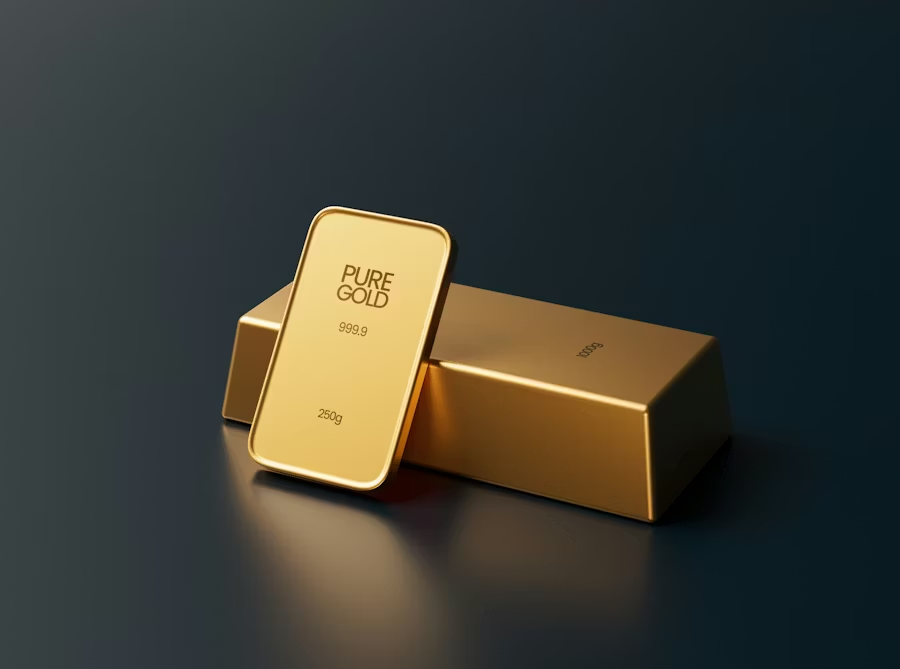
Why Premiums Matter More Than You Think
When you buy gold, you pay spot plus a premium. Spot is the market price. Premium is fabrication, distribution, and profit.
Here’s where it gets real.
Gold trades at $2,000/oz. You buy an American Eagle for $2,100. That’s a $100 premium (5%). You sell it back. The dealer gives you spot plus $20.
You lost $80 in transaction costs. Just like that.
Rounds carry lower premiums. Quality 1 oz rounds run $40-50 over spot. Some generic rounds cost even less.
Government coins like Eagles, Maples, and Krugerrands command higher premiums. They’re recognized worldwide. Governments guarantee them.
Is that recognition worth $50-80 per ounce? Depends on your goals.
What it means for you: Every dollar in premium is a dollar not buying gold. Calculate your break-even before buying.
What Actually Happens When You Sell or Trade
Here’s what happens when you need cash fast. Different pieces get different treatment at dealers.
American Gold Eagles sell immediately. Good prices. No haggling. Dealers barely test them. They know what’s real by look and feel.
PAMP Suisse rounds sell for basically spot price. Dealers test them more carefully. Fair price but not as good as Eagles.
Then the surprise with larger bars.
Large bars are hard to verify. Easy to fake. Tough to resell. One dealer might make a lowball offer. Another might pass entirely.
For barter situations: One-ounce rounds work best. Nobody gives change for a 10 oz bar worth $20,000. A one-ounce round at $2,000 is realistic. Silver works better for small purchases.
What it means for you: Liquidity matters more than premium savings when you actually need to sell.
🎯 Free Download: Retirement Rescue Gold IRA Playbook
Learn how to protect your retirement savings from currency collapse. Complete guide to Gold IRA rules, fees, and custodian selection.
Get the Free Playbook →
The Counterfeit Problem Nobody Discusses
Fake gold is getting scary good. Really scary.
Chinese counterfeiters make tungsten-filled bars and coins. Tungsten has almost the same density as gold. Weight and size can be perfect. Only detailed testing catches them.
Government coins are hardest to fake. Complex designs. Edge reeding. Specific dimensions. Dealers know them intimately.
Gold rounds are easier to fake. Reputable mints (PAMP, Perth, Royal Canadian) include security features. Generic no-name rounds don’t.
Gold bars are easiest to fake. Simple rectangular shape. No design complexity. Experienced dealers have been fooled by quality fakes.
⚠️ Counterfeit Protection Rules:
• Buy from established dealers only
• Stick with recognized private mints
• The $10 you save on a no-name round isn’t worth the risk
• Consider a Sigma Metalytics tester ($800-1000) for serious stacking
What it means for you: Cheap gold is expensive if it’s fake. Pay the premium for legitimate sources.
Storage and Security Considerations
Gold is dense and compact. Easy to hide. Easy to steal.
Rounds and coins are about equal here. Both fit in small safes. Both work for safety deposit boxes. Both can be hidden in multiple locations.
Don’t put all emergency assets in one place. That’s basic operational security.
Some people bury gold. Rounds and coins work better for this. You can use many smaller containers.
Big bars are more storage-efficient. A 400 oz gold bar is only 10 x 3.5 x 7 inches. But unless you have $800,000+ in gold, you’re not buying 400 oz bars.
For most preppers with $10,000-100,000 in gold: rounds and coins in a home safe work best. Split between safe and safety deposit box.
One advantage of rounds and coins: More portable in bug-out situations. You can stuff 1 oz rounds in a small pouch. Try that with 10 oz bars.
Liquidity When Things Get Bad
Let’s talk worst-case scenario. Economic collapse. Currency devaluation. SHTF situations.
Government coins win here. American Eagles. Canadian Maples. South African Krugerrands. Austrian Philharmonics. Recognized globally. You can take an American Eagle anywhere and sell it.
Quality rounds from known mints are liquid too. PAMP Suisse. Perth Mint. Royal Canadian Mint rounds. Dealers recognize them. Generic rounds are harder to move.
Bars have liquidity issues. A 100 oz bar from a major refinery will sell. A 1 oz bar from “Bob’s Gold Refinery” raises eyebrows.
In true crisis situations, people default to what they recognize. That favors government coins and well-known rounds.
If buying gold primarily as a crisis hedge: mix it up. Some recognizable coins for liquidity. Plus rounds to reduce average premium cost.
For a detailed analysis of the most recognized IRA-eligible coin, see our American Gold Eagle review.

The Math on Long-Term Value
Here’s where the gold rounds comparison gets interesting.
You have $10,000 for gold. Gold is at $2,000/oz.
Scenario 1: American Gold Eagles
• Cost: $2,100 each (5% premium)
• Quantity: 4.76 Eagles
• Gold content: 4.76 oz
Scenario 2: Quality gold rounds (PAMP, etc)
• Cost: $2,050 each (2.5% premium)
• Quantity: 4.88 rounds
• Gold content: 4.88 oz
Scenario 3: Generic gold rounds
• Cost: $2,030 each (1.5% premium)
• Quantity: 4.93 rounds
• Gold content: 4.93 oz
Difference: 0.17 oz between Eagles and generic rounds. At current prices, that’s about $340.
Gold goes to $3,000/oz (50% increase). You need to sell.
Eagles: Sell at $3,100 each = $14,756
Quality rounds: Sell at $3,025 each = $14,762
Generic rounds: Sell at $3,000 each = $14,790
Generic rounds net you the most. You bought more ounces initially.
But this calculation misses selling ease and speed. Eagles sell same-day. Generic rounds might take longer.
For long-term wealth preservation: rounds make more sense financially. For emergency liquidity: coins have the advantage.
What it means for you: Balance matters. Lower average cost plus solid liquidity equals smart stacking.
What About Fractional Sizes?
Everything above assumes 1 oz pieces. You can buy 1/2 oz, 1/4 oz, and 1/10 oz rounds and coins.
The premiums get brutal. You might pay 10-15% over spot on a 1/10 oz coin. Huge markup.
But for barter, fractional gold makes sense. Trading a full ounce ($2,000+) for everyday goods is impractical. A 1/4 oz round at $500 is more realistic. Still pretty valuable.
Most preppers prioritize silver for small transactions. A 1 oz silver round at $25-30 buys a week’s worth of food or a tank of gas.
If you want fractional gold, rounds are cheaper than coins. Premium is high but not as brutal.
What Dealers Actually Tell You (When They’re Honest)
Here’s what experienced dealers know but rarely say publicly.
They make more profit on government coins. Higher premiums. More margin. They push Eagles and Maples harder.
Rounds are tougher sells. They have to educate customers. Overcome skepticism. Hold inventory longer. They prefer selling coins.
They personally stack rounds. Multiple dealers buy rounds for their own holdings. Premiums make sense when you’re not reselling.
Market incentives favor coins. That inflates premiums beyond justified utility difference.
When a dealer pushes Eagles hard, get skeptical. When they show both options honestly, trust them more.
Compare custodian options in our Best Gold IRA Custodians guide.
Recommended Setup and Why
Here’s a balanced approach that makes sense for most preppers:
- 40% in American Gold Eagles and Canadian Maples (maximum liquidity and recognition)
- 45% in quality rounds from PAMP Suisse and Royal Canadian Mint (lower premiums, solid recognition)
- 10% in generic rounds (lowest premiums, bought when cash is tight)
- 5% in fractional coins (for flexibility)
This mix gives options. Need to sell fast? Eagles work immediately. Not in a hurry? Shop around with rounds.
The generic rounds are honestly a weak link. Harder to sell. Quality rounds are worth the small extra premium.
Starting fresh today: 40% government coins, 60% quality rounds. Minimizes premiums. Maintains good liquidity.
Which Actually Wins? The Bottom Line
For pure wealth preservation at lowest cost: Quality gold rounds from recognized private mints. PAMP, Perth, RCM. Real gold at lowest premiums. Liquid enough for most purposes.
For maximum crisis liquidity: Government gold coins. American Eagles especially. You pay more upfront. They sell easier and faster.
For smart balanced approach: Mix of quality rounds (60%) and government coins (40%). Cost efficiency plus liquidity.
Avoid: Generic no-name rounds (unless extremely cheap). Small gold bars (poor liquidity). Fractional gold (premiums too high).
Starting out with one or two pieces? Get an American Eagle first. You’ll never have trouble selling it. Solid foundation.
After that, buy quality rounds to add ounces efficiently.
The gold rounds comparison comes down to your situation. How much liquidity? How price-sensitive? How sophisticated are potential buyers in your area?
No perfect answer. There is a right answer for your specific goals.
Learn the complete rollover process in our guide on how to roll over your 401(k) into a Gold IRA.
🔍 Frequently Asked Questions
Click to Expand Frequently Asked Questions
Are gold rounds a good investment?
Yes, for wealth preservation. Rounds contain the same gold content as coins at lower premiums. You get more ounces per dollar. For long-term holding, they’re excellent. For emergency selling, government coins work faster.
What’s the difference between gold rounds and gold coins?
Minting authority. Governments mint coins with face value. Private companies mint rounds with no face value. Both contain gold. Coins carry higher premiums due to recognition and government backing.
Can I put gold rounds in an IRA?
Some rounds, yes. IRS requires .9999 purity for most gold in IRAs. American Gold Eagles are the exception at .9167. Many private mint rounds qualify. Check with your custodian before purchasing.
Which gold rounds are best?
PAMP Suisse, Perth Mint, and Royal Canadian Mint are top choices. Recognized globally. Include security features. Sell at good prices. Avoid generic no-name rounds.
Are gold rounds easier to fake than coins?
Somewhat. Government coins have complex designs that counterfeiters struggle to copy perfectly. Quality rounds from reputable mints include security features. Generic rounds are easiest to fake.
Should I buy gold bars or rounds?
Depends on your amount. Under $50,000? Rounds and coins. Over $100,000? Consider adding bars from major refineries. Small bars (1 oz) have liquidity problems. Large bars (10+ oz) are more efficient.
How much premium should I pay for gold rounds?
Target 2-3% over spot for quality rounds from recognized mints. Generic rounds run 1-2%. Anything over 5% is too high unless it’s a rare collectible.
Where should I buy gold rounds?
Established dealers only. Online dealers like JM Bullion, APMEX, and SD Bullion are reputable. Local coin shops work too. Avoid eBay, Craigslist, and unfamiliar sources.
Can I use gold rounds for barter?
Yes, but silver is better for small transactions. One ounce of gold is worth $2,000+. That’s too much for most exchanges. Silver rounds at $25-30 are more practical. Keep some gold rounds for larger transactions.
How do I test gold rounds for authenticity?
Use a Sigma Metalytics tester. Runs $800-1000. Tests conductivity. Worth it for serious stackers. Also use ice test, weight test, and magnet test as quick checks. Buy from reputable sources to minimize risk.
The Bottom Line
The difference between rounds and coins matters less than owning gold versus paper assets. Start somewhere. Learn as you go. Adjust your strategy. Real assets can’t be printed away. They can’t be devalued by government policy. Build your position. Protect what you’ve earned.
Your dealer made more profit on that Eagle than he’ll ever admit. The question isn’t what he wants to sell. It’s what you actually need to own. Rounds, coins, bars. Each serves a purpose. None is perfect. The right mix depends on whether you’re optimizing for cost, liquidity, or crisis readiness. Most stackers get this wrong because they never asked the right questions.
Continue Your Wealth Protection Education
Build your complete precious metals strategy with these essential guides:
• What Is A Gold IRA? — Complete beginner’s guide
• How to Roll Over Your 401(k) Into a Gold IRA — Step-by-step transfer process
• Gold vs Stocks vs Cash — Which protects wealth better?
• Best Gold IRA Custodians — Vetted company reviews
• American Gold Eagle Review — Government-backed coin analysis
📚 Legal Information
For complete transparency and your protection, please review:
- Privacy Policy — How we protect your information
- Disclaimer — Important limitations on content and advice
- Affiliate Disclosure — How we earn commissions transparently
- Terms of Service — Legal agreement for website use
Part of our commitment to full transparency and legal compliance.